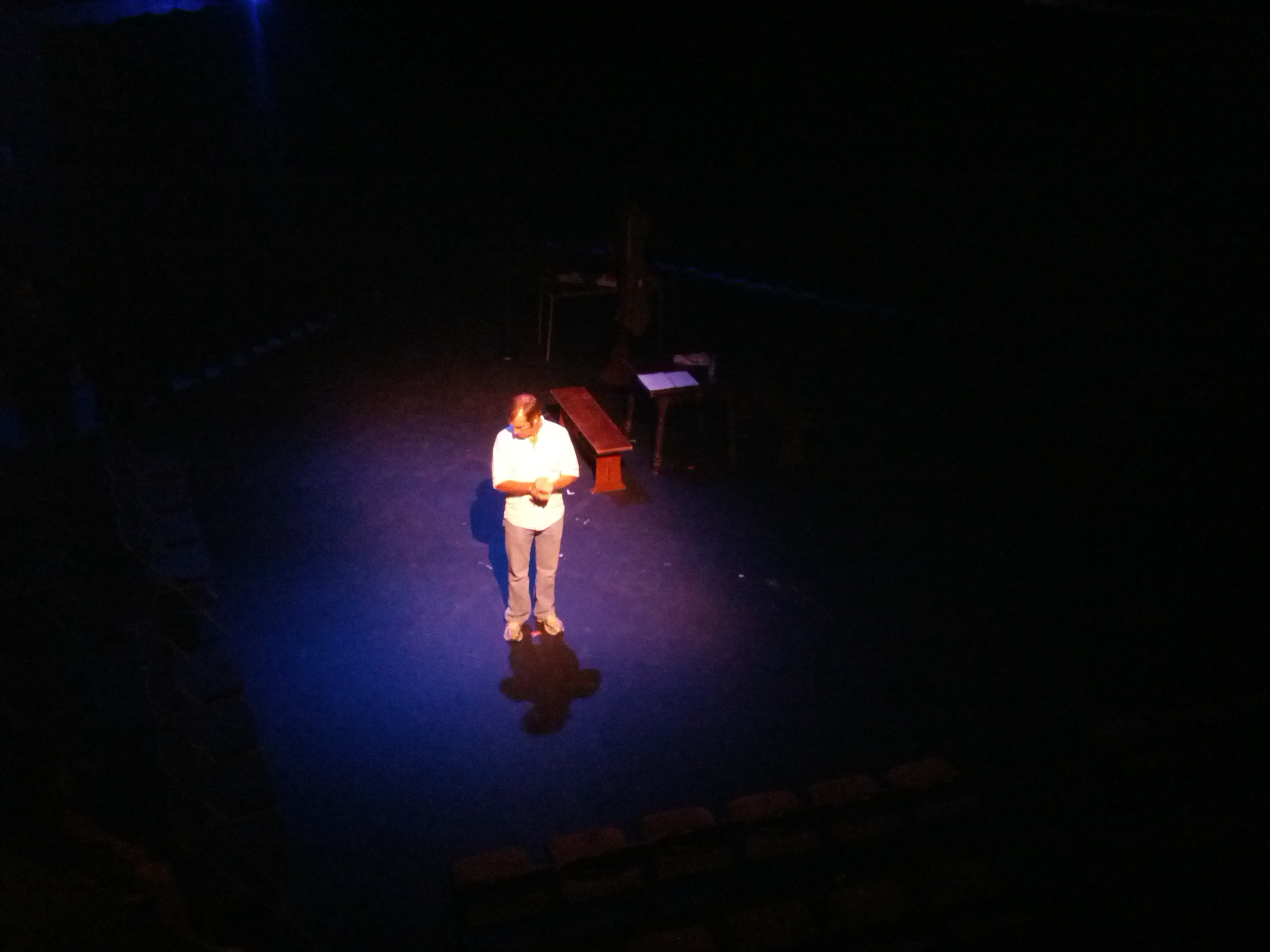
David Compton: The Actor Who Could Play Anything

When you look someone in the eye, just look, holding the gaze or the glare, allowing the seconds to tick by, not speaking but studying in silence the shape of the face, the lines, the contours, yet always returning to the eyes, and being vulnerable enough to allow the observer of you to do likewise, can be as truthful and revelatory a moment as any person can have in their life. An actor is a truth-seeker. When an actor goes on stage, it is with the intention to look into the eyes of their opposite and not just speak the truth, but see it and draw it out in the other. When done well it is thrilling for the actors involved and riveting for an audience to watch. Whoopi Goldberg said, “An actress can only play a woman. I’m an actor; I can play anything.” My dear friend, David Compton could play anything. I envied him. He made me jealous. I stole from him. I tried to detect falsehood when I watched him and always gave up after a few seconds. There were two roles for which I entertained the notion of auditioning when Nashville Repertory Theatre announced the auditions: The Old Man in “The Christmas Story” and the Emcee in “Cabaret.” What was I thinking? Who was I kidding? What reality was I trying to bend? David embodied those two roles, as in all roles he accepted, with a force that made each character he portrayed reach transcendence. When he played Sherlock Holmes in Nashville Children’s Theatre's production of “Sherlock Holmes: The Final Adventure,” my jaw dropped to the floor in those opening scenes and remained there for the entire performance. After multiple doses of Advil, I finally got the feeling back in my face. I only saw him break character once, and it was my fault entirely. In “The Christmas Story,” David also was part of the Ensemble, and he played the old Schoolmarm. At the same time, I was in a production of “A Christmas Carol” playing Scrooge, a production that included Amanda Compton, David’s gifted and lovely wife. On a night off, I went to see “A Christmas Story,” and when David came out in his Schoolmarm dress and red wig and began to address the class, which included members of the audience, he looked at me and began to berate me for misbehaving…a totally bogus charge. However, David was enjoying himself at my expense. He finished by asking me if I had anything to say for myself. I thought for a second and responded with, “Bah Humbug?” It took several beats for him to get control. It was pure joy for both of us. In two rare acting combinations, David and I played bitterest enemies in one production and best friends in another. We were cast in Nashville Rep’s production of “To Kill a Mockingbird,” David as Bob Ewell and I as Atticus Finch. (It was also the first time I had the privilege to work…
Comments Off on David Compton: The Actor Who Could Play Anything

Life Skills vs. Google G.P.S. Part Deux

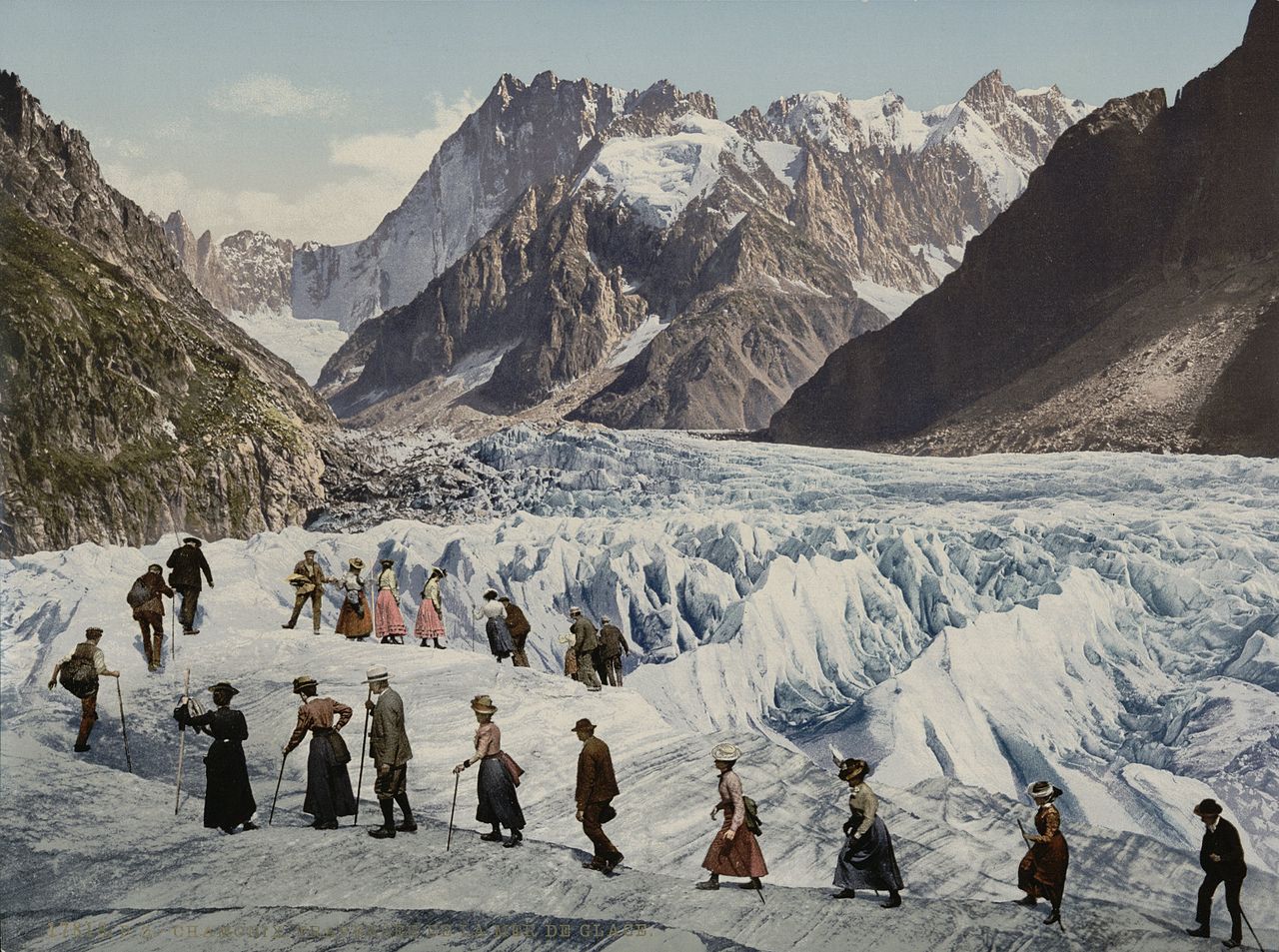
With our daughter safely on the train to Avignon, Kay and I found ourselves arriving in Annecy shortly before nightfall. Our modus operandi when we travel abroad is to book a few nights in B&B’s or hotels in certain locales beforehand, and then once we are on the ground, have the flexibility to deviate from the path. We arrive in a city or village and book something that suits our fancy in the moment, stay longer in one location, or bounce to another. Risky behavior, I know, but that is the fun of unexpected circumstances and special encounters while traveling. We had booked the apartment in Paris at the top of trip, a B&B in Mont St. Michel, a one-night stay in St. Jean in the Pyrenees (ended up being three nights because we loved the place and the location), and a two-night stay in Annecy. We were going to explore the French Alps, and Annecy was the perfect jumping-off location. Other locations we chose on the fly. I must admit that as night fell on Annecy and we were unable to find the location of our B&B, I reluctantly thought a pre-programmed G.P.S. would have been helpful, but would I confess that to my daughter? Never. We knew we were close, but could not zero in on the exact location. It had been a long day of driving and we were fading, so I had Kay pull over at a random location, I hopped out and went inside a hotel and booked a room. As good fortune would have it, our third floor, balcony window looked out onto the cobblestone street where only pedestrian traffic was allowed. It was the Old City section filled with quaint craft and gift shops and restaurants. Annecy is sometimes called the Venice of the Alps because of its two canals and the river Thiou running through the Old City. At dinner the following evening we were placed in open-air seating of a nice restaurant cheek-by-jowl with three other couples: German, Swiss, and French. Between the four couples, there were enough universal gestures and elementary language skills for us to communicate although most of the time we just laughed and shrugged our shoulders at our lack of fully understanding one another. At least we were not negotiating international treaties, just enjoying a meal in close proximity. We planned a day trip up to Chamonix, and again “Wrong-Way” Arnold, got us off the path requiring a ten kilometer backtrack. I gave myself a consolation prize for continuing to reduce the backtracking distance, and by happy coincidence, the wrong direction for Chamonix just happened to be the correct direction for our continuing journey toward the Pyrenees the following day. Unbeknown to me, Kay had programmed her phone with G.P.S. tracking the direct route from Annecy to Chamonix, and she kindly offered it as an addition to the map. I took it, but did so without gratitude. The last thing I wanted was to be indebted to a little…

Comments Off on Life Skills vs. Google G.P.S. Part Deux
Read more about the article Life Skills vs. Google G.P.S.
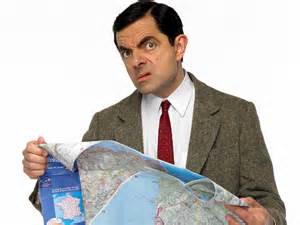
Rowan Atkinson as Mr. Bean

Life Skills vs. Google G.P.S.

I love maps especially the old medieval kind where the mapmakers used their powerful imaginations depicting fantastical images of monsters in an attempt to explain the dark and dangerous mysteries of lands and vast oceans yet discovered. The visionaries looked beyond their immediate horizons and envisioned the wonders of the unexplored. No such monsters to be found on the Michelin highway map of France, but my heart still palpitated at the thought of navigating this wonderful country, and after three days of tromping around Paris with miles logged and Fitbit merit badges for Kay, it was time venture out. By my clockwise count on the Michelin map there are seventeen main entrées (not the main course, but the right of entry) and/or sorties (not the military attack, but the brief trip away from) leading into and out of Paris. The nice lady at the rental car place gave us a city map; however, the reality on the ground was a bit different than simply following her green highlighted route out of Charles De Gaulle airport into the countryside. The highway arteries from the center of Paris have a spider web effect that created a feeling of consternation similar to Rowan Atkinson’s expression in the cover photo of this essay after looking at his map. Add to our departure: a pouring rain, rush hour traffic, and the unfamiliar French road signage. All this proved a formidable challenge, but one I embraced with an explorer’s zest. Bring on the monsters. Once we were zipping along in the car, I gave up trying to follow the city map given me by the rental car lady, and by my best calculation in the moment, chose the sixteenth highway of the seventeen available choices out of Paris. I overshot it by one. Kay was doing an excellent job driving: changing lanes, weaving through traffic, and making quick highway transitions on my short-notice commands like a calm professional. I call her “Mario” for the racing legend not the video game character. We stopped once to get verbal directions, and after a couple of wonderful, albeit humorous encounters with congenial Parisians (language barriers make for elaborate gesticulations and elevated voices), we were on the road with only about thirty kilometers of backtracking to do. We also had our youngest daughter, Lauren Blair Zilen, in the backseat. She was traveling with us for a few days before striking out on her own. L.B. is a savvy traveler, but her choice for directional guidance is to use the high-tech G.P.S. navigation provided by Google Maps. She remained patient and even helpful to her snobbish father pointing out road signage. Her extra pair of eyes was beneficial. And I need to add here that she bought the Michelin map presenting it to me with a mixture of good humor and admiration when we met in Paris at the beginning of our trip. Out of Paris with clearing skies ahead, we made our way through the beautiful landscape heading west toward…

Comments Off on Life Skills vs. Google G.P.S.

Fear Factor

For the last few years Kay and I have had the opportunities to travel to places we’ve dreamed about for years but been unable to afford. A relative on Kay’s side of the family has been generous with monetary Christmas gifts, and we have chosen to use that gift to fund travel. We booked two weeks for a France excursion with daytrips into Switzerland and Spain as we moved around the country. When we started booking our B&B’s, we discussed driving north to Brussels from Paris for a couple of days, but opted to go south instead. Then the terrorists struck in Brussels. It never occurred to us that we should cancel our trip. I recently heard a statistic that stated you are seven times more likely to die from being hit by a falling object than by a terrorist. Mark Twain said, “It’s easier to fool people than to convince them that they have been fooled.” With that in mind, I watched the film “Trumbo” about screenwriter, Dalton Trumbo, who was caught up in the exposing of members of the Communist Party during a period in American history known as “the red scare.” This registered party was as legitimate and legal a political entity as the Republican and Democratic parties. About the same time the Dixiecrats (a splinter from the Democratic Party which gave us the likes of Senator Strom Thurmond) was also formed on the sole platform of segregation and state’s rights; these folks still seemed eager to fight the Civil War that was settled over a hundred years before and had claimed the lives of over 600,000 American citizens before the powers that be stopped the madness. But in 1948, nobody in Congress seemed to think that the members of the Dixiecrats were worthy of Senate Committee hearings. The Communist infiltrators that were secretly taking over our government in the late 1940’s into the 1950’s were hauled before Congressional tribunals for the main purpose of allowing the likes of Senators Joseph McCarthy and Richard Nixon to show the country they were earning their paychecks by protecting our vulnerable nation from the communist infestation. The only people during that time who actually went to jail were primarily Hollywood screenwriters who had chosen to exercise their right to free speech and assembly by joining the Communist Party. These people never broke any laws. Then in 1954, the Senate voted 67 to 22 to censure McCarthy for his over-reaching “red scare” tactics, one of the few Senators ever to be disciplined in such a fashion. Three years later he died in disgrace from the effects of alcoholism. And twenty years after these Senate hearings, Nixon gave us Watergate. A few years ago, I had the privilege of doing a production of Arthur Miller’s play, “The Crucible” for Nashville Repertory Theatre. Miller wrote the play during the time of the “red-scare” Senate hearings and set the story during the Salem witch trials in Massachusetts from 1692 to 1693. Some of the religious leaders…

Comments Off on Fear Factor

Scot Copeland: Man with the Dragon Tattoo

In honor of my friend, Scot Copeland, who shuffled off his mortal coil on this day a year ago, I am re-posting this remembrance. He has left a hole in the hearts of many across this land, and while his work will be celebrated on into the future, it is the heart of the man that we cherish and hold dear. God bless you, B.A. 3, and Rene, and Josh and Ben. Back in 1951 some friends of Groucho Marx pressured him to join the Friar’s Club of Beverly Hills. He never participated in any of the club’s activities, and after his short-lived membership, he wrote a letter of resignation to the president of the club. The president responded immediately with his own letter asking for an explanation for his abrupt and unexpected departure, and Groucho promptly wrote back: “Because I don’t want to belong to any club that would accept me as a member.” In his lifetime, Scot Copeland was given awards and memberships to many organizations, but there was a little known club to which he belonged that was so exclusive it had only three members: the Bad Ass Club. Its origins began years ago through an unusual set of events. In the summer of 1999 after her first year of college, my oldest daughter, Kristin, had a suitor she had dated at college pay a visit to the farm. He had expressed his affections, and Kristin entertained the notion that this relationship had potential. But after a couple of days of close quarters, Kristin knew this was a dead end street and put the poor boy on the plane in tears at the end of his stay. She was a bit melancholy after returning from the airport, and so Kay and I decided we would take her out to dinner and cheer her up. Kristin and I got into the car, I in the driver’s seat and Kristin scooting into the back seat, and we waited in the driveway for Kay to join us. I looked in the rearview mirror and saw my daughter’s downcast eyes. “Honey, I know it’s tough but you did the right thing. I’m proud of you,” I said, but my vote of confidence in her judgment on ending this romance received a tepid, “Yeah. Thanks, Dad.” So I tried the big-picture approach. “So Kid, when you are imagining the guy you would fall in love with and see as a lifetime partner, what kind of guy would he be?” She was quiet for a moment, the sound of the idling car engine filling the silence, and then she responded. “I want a Bad Ass like you, Daddy.” And she paused briefly before adding. “…and Robert Kiefer.” My heart swelled with pride. Even if it wasn’t true, the fact that she believed it and stated it was enough. I wanted to be sure of the veracity of what she said and looked into the rearview mirror once again. She bore a solemn countenance;…

Comments Off on Scot Copeland: Man with the Dragon Tattoo
Read more about the article Strange Bedfellows – Part Deux
Renoir

Strange Bedfellows – Part Deux

So how did this courtship begin? There were a few chance and premeditated encounters, memorable and brief, but nothing of consequence until that fateful day on a frozen pond in January of 1978. Prior to graduating from UNC in Chapel Hill, N.C., with my Master of Fine Arts degree in acting in December, 1977, I got a call from the artistic director of the Advent Theatre in Nashville, Tennessee informing me that I had been hired for the upcoming season. I had auditioned earlier that fall, and I was excited by the prospect of becoming a founding member of this new professional theatre company. For an actor to have work before graduating was a happy rarity and to be back in the city where I grew up and begin a career among family and friends was sweet indeed. Once back in town, I started attending a non-denominational church on Music Row.  There was a large singles' contingent in the church, some of whom I knew well.  Many of us were coming out of the sixties & seventies, hippy experience looking for a deeper and continuous relationship with a personal God that went far beyond the traditions and rituals offered by most institutional churches. It was the dead of winter with a sustained, sub-freezing cold spell long enough to ice over small ponds to a thickness that could support multitudes.  One Sunday afternoon a dear friend whom I had known since high school invited me to a church singles' gathering at a farm to play broom hockey, a rare winter sport for the southland.  I was not all that interested until my friend informed me that Kay Patton would be there.  This friend, her inner matchmaker well tuned, was persuasive.  I had observed Kay at church once I returned from North Carolina and had commented earlier to my friend how attractive I found her. Her current romantic status was “Officially unattached,” but she had at least three other aspiring suitors.  That day, two of those three would be counted among the singles' group at this winter happening.  If I was to have any shot at getting her attention, I needed to move fast and make her aware of me, i.e., move to the head of the line by any means necessary removing the competition. It was BYOB for this event, “Bring Your Own Broom,” so I rushed to the store and bought my first straw broom, not to clean house but to sweep the opposition out of the way and maybe, in the process, sweep Kay off her feet.  The teams were chosen, a fairly even male-to-female ratio on each team, with the object being to sweep a soccer ball up and down the pond and past your opponent’s goalie for a score. Our form of this hockey game used a soccer ball for a puck, a broom for a hockey stick, and your standard Timberland hiking boots for skates.  In the course of the game, I was not above inflicting bruises…

Comments Off on Strange Bedfellows – Part Deux

Strange Bedfellows

In the spirit of the Valentine season when warm and amorous feelings are expressed to our significant others, I thought I would write about the one who caught my eye several decades ago. So with Shakespeare’s admonition, “Never durst poet touch a pen to write / Until his ink were temper’d with Love’s sighs,” in mind, I will venture a few thoughts on being a victim of Cupid’s arrow. Kay and I could not be more opposite: farm girl vs. city boy; introvert vs. extrovert; psychology counselor vs. actor & writer; serene and contemplative vs. sarcastic and cranky; Jedi Master Yoda vs. know-it-all Han Solo.  Early in our courtship, Kay was warned more than once not to get involved with me. A well-meaning church-lady even said of our courtship and prospective marriage that, "it would never work out." It is certainly within the realm of possibility that such extreme personalities could be attracted to each other.  There was and is and always will be our physical attraction to one another—we still like to flirt and tease—but along the journey of almost thirty-seven years of marriage to date (May 12, 1979 to be exact), we have taken the risks and opportunities to go beyond the physical and expand the depths of our human connection with one another, a special challenge when the two personalities involved in this quest are polar opposites with “irreconcilable differences.” A few years ago in Philadelphia while having breakfast around a large table in a house shared by seven, twenty-something, single women, one of whom was our youngest daughter, Lauren, one of the young ladies asked, “How did you two get together and how have you stayed together?”  The Questioner had appraised Kay and me after only a brief time of observation and so posed the question in amazement that we should have first, been attracted to each other, and second, that the marriage had lasted so long. We began the conversation by referencing the “Star Wars” analogy to illustrate our opposite personalities: Kay, the supremely composed Yoda calmly appraising situations and dispensing wise solutions, and I, Han Solo, who happens upon a discarded lightsaber, picks up the curious object and bangs it on a rock shouting, “How does this thing work?” to which Kay responds with, “Just push the ‘on’ button,” then rolls her eyes in dismay.  From that jumping off point the collected memories of our courtship and life together began to flow uninterrupted throughout the morning, soaked with laughter and tears, and ended well into the afternoon. Strange Bedfellows is certainly a catchy phrase. Like politics, for which the phrase was originally coined, marriage can make strange bedfellows.  It was Charles Dudley Warner, the 19th century American writer and contemporary of Samuel Clemens (they co-authored The Gilded Age, a novel that satirizes greed and political corruption in post-Civil War America), who created the original phrase: “Politics makes strange bedfellows.”  The truism “strange bedfellows” has a universal meaning that can apply to any human institution…

Comments Off on Strange Bedfellows

Black Fabric

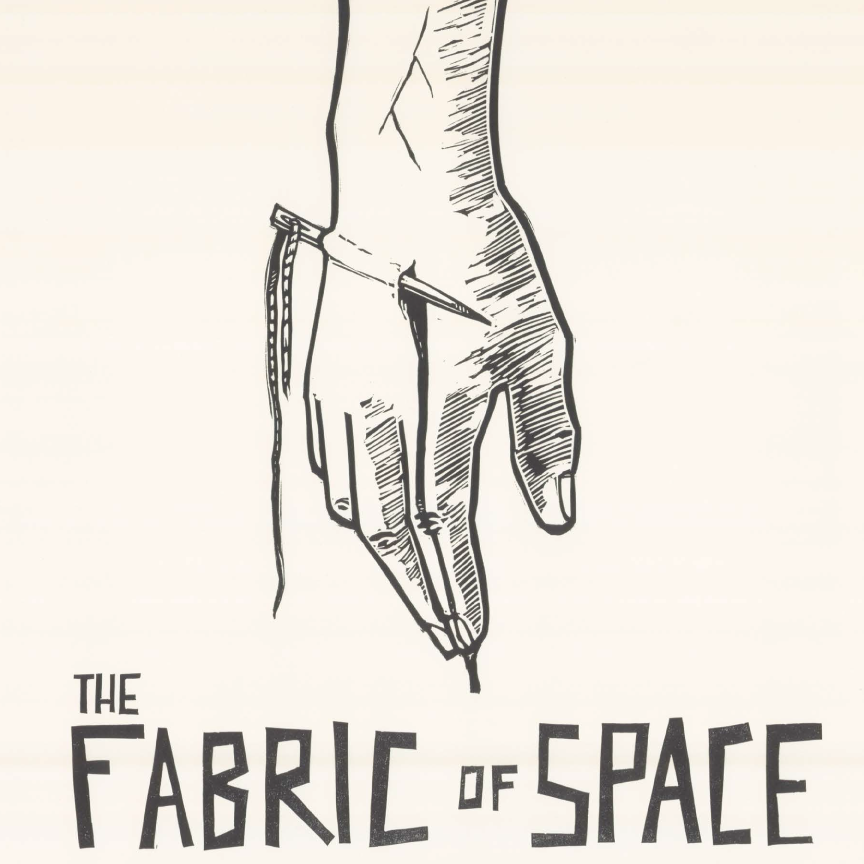
Black has to be the most ancient of colors. The book of Genesis states that it is the black darkness that shrouds the Spirit of God while contemplating the formless void before speaking the light into existence. There is no reflection in the color black. Black swallows all color concealing deeper mysteries. One of my favorite artists is Caravaggio, the Baroque painter whose bold, rich colors were more vibrant and profound because of his lavish use of the color black and its shadowy shades in each canvas. Most often when Caravaggio used light it was to illuminate the human actions of his subjects frozen in dramatic performance and often with postures and expressions of anguish or wonder or radiance. In the opening scene of the film “The Fabric of Space,” a father and son lie on the ground contemplating the wonder of the black sky above them pierced with tiny pinpricks of starlight and what it might be like were they to be flung into all that space. I’ve been asked by several people who have watched this film as to its possible meaning. I feel honored by those inquisitive enough to ask about our process in creating such a story. It seems their imaginations had been “flung into space” by the film. One person even said, “I don’t fully follow the tale, but I am scared every time I watch it.” Life can be unpredictable, I reminded them, and sometimes dangerously so. Events and people can change suddenly and drastically. There is only so much we can do in our efforts to safeguard against unpredictable and unwanted disruption in our lives.   When Derek Pearson and I were discussing this abstract notion of the coexistence of spirit and body and what might happen when they separate, we went further with the storyline and began giving it muscle and bone: how the father would witness the unexpected departure of his son’s spirit from his body; how the father would chase after his son’s spirit into a dark forest where he comes upon an extraordinary character weaving a giant fabric; and how the father would desperately bargain for his son’s life in exchange for his own. When Derek said he planned to shoot his film in black and white, I thought of Rod Serling and “The Twilight Zone.” This concept was in homage to the genre created by that great television show. Meaning, like beauty, is in the eye of the beholder, and assigning specific meaning to works of art risks impertinence. I see something different each time I watch the film. There is a poetic phrase we use when we are certain of something: “Without a shadow of a doubt.” I have learned to be comfortable with my doubts, which may mean I am comfortable remaining in the shadows when offering any definitive meaning to this film. Remember, in this dreamlike world Derek has created, anything can happen that would offer multiple meanings, and he uses the palette of black…

Comments Off on Black Fabric

Not a Team Player

Life will often surprise us with a dose of reality that rearranges our private universe in unexpected ways. The incident can be the equivalent of tasting the forbidden fruit. While the experience might expand the knowledge of ourselves and the place we inhabit in the world, it can also reveal something about our character we may have never known before leaving us feeling naked and in need of covering in a garment of fig leaves. To belong and be accepted is a vital part of being human and central to our survival. I do not believe anyone who says they don’t care what others think of them. We are, in part, exactly what people think of us for better or worse. In this second chapter of “My Better Angel,” I write of the young protagonist's hope to make the final cut of a Little League team. He arrives at the baseball field right after landing a job as a paperboy to hear the final verdict announced by the coach. The outcome makes an indelible mark on his soul. Though last month's first chapter, "Staying Power," and now this second one are told in first person, I again admonish the reader to remember it is only fiction. Not a Team Player In the heat of my first employment, I saw the world as fruitful.  To have a job at my age with such freedom and responsibility would make my friends envious at my graduation from parental allowance to self-regulating earned income.  I never could tell my friends I didn’t receive an allowance because my father’s income was unable to compete with the lawyers, doctors, stock brokers, and bank vice presidents who never blinked at the size of the checks they wrote to the private religious school we all attended.  Allowance for my friends inspired more one-upmanship than any thought of gratitude, but I saw allowance as familial welfare, a way to manipulate and enforce authority.  And I could imagine the girls at school awed in the presence of a boy who has severed the parental purse strings.  I was stepping outside the safe confines of what I had known, and a flicker of potential new worlds stirred the juice in my system. I coasted onto the Little League field where other boys, their parents and the coaches gathered at the stands.  I parked my bike behind the bleachers and swaggered to the front trying to squelch the unchristian pride I felt at just having stepped into a wider world.  In restrained tones I spoke to my schoolmates as I took a seat among the group.  Every summer the school we attended sponsored a Little League team.  Baseball was a rite of passage for the chosen few and we all wanted to be chosen.  I thought being a future Wildcat would be an added breadth to my destiny. For days leading up to tryouts, baseball dominated the minds of my contemporaries. During the two-day tryout period where the coaching staff tested our…

Comments Off on Not a Team Player

Staying Power

"The world never comes at you all at once," John O'Donohue states in his book "Beauty, The Invisible Embrace." If it did we would combust. Most moments in life barely register; others leave an impression that remains for a lifetime. I had two seminal experiences that helped me shed the skin of childhood. One evolved over a period of time bringing with it a gradual awareness of a wider world beyond the borders of my rather sheltered existence. The other was a revelation into my character that came like a lightning bolt. I became a paperboy at a young age, and around the same time, I tried out for a Little League baseball team. A few years ago I decided to write a coming-of-age novel based on some of my early experiences growing up in the 1960s. The novel is entitled “My Better Angel.” It has yet to be published due, in part, to my own inertia. So just for the fun of it, I’ve decided to post the first two chapters of the novel on my website. The first chapter is entitled “Staying Power.” I will post the second chapter in December. This is fiction. I was a paperboy, and I did tryout for Little League. Those are facts beyond repute. The rest I will leave for the reader’s imagination. It is simply written to delight. Chapter 1 Staying Power “So you threw the papers for one of the boys while he was on vacation,” Aaron Rubenstein said.  He snorted a staccato sniff of early morning air up his bulbous nose sounding like baseball cards’ flapping against bicycle spokes.  I detected a hint of condescension. “Threw for a whole week,” I said, unable to hold back a little crow. “Threw for a whole week,” Aaron said glancing heavenward as though the statement was worthy of contemplation. Aaron was a paperboy for our two daily newspapers in Davis City, Tennessee: the morning Sentinel and evening Monitor.  I had had a whole week of experience, enough, I thought, to qualify me for a route of my own, but as Aaron stared into the pre-dawn sky, his silence allowed for doubts to creep into my mind.  Aaron had impressed the newspaper’s delivery managers and they promoted him to a larger route after a year of delivering the papers for the route I hoped, with his blessing, would assume.  I had passed the interview with the managers.  The last hurdle was the approval of Aaron Rubenstein.  We had met before dawn at the drop-off site where the route manager left designated bundles of papers for the paperboys to pick up before heading out on their neighborhood routes.  Even though Aaron and I would have two different routes, we would gather our paper bundles at the same drop-off site beneath a giant hickory tree. “Throwing for a week of four‑thirty mornings and three‑thirty afternoons is like slipping off a wet rock, nothing to it,” he said redirecting his eyes on me. Condescension confirmed.  Shamed, I…

Comments Off on Staying Power